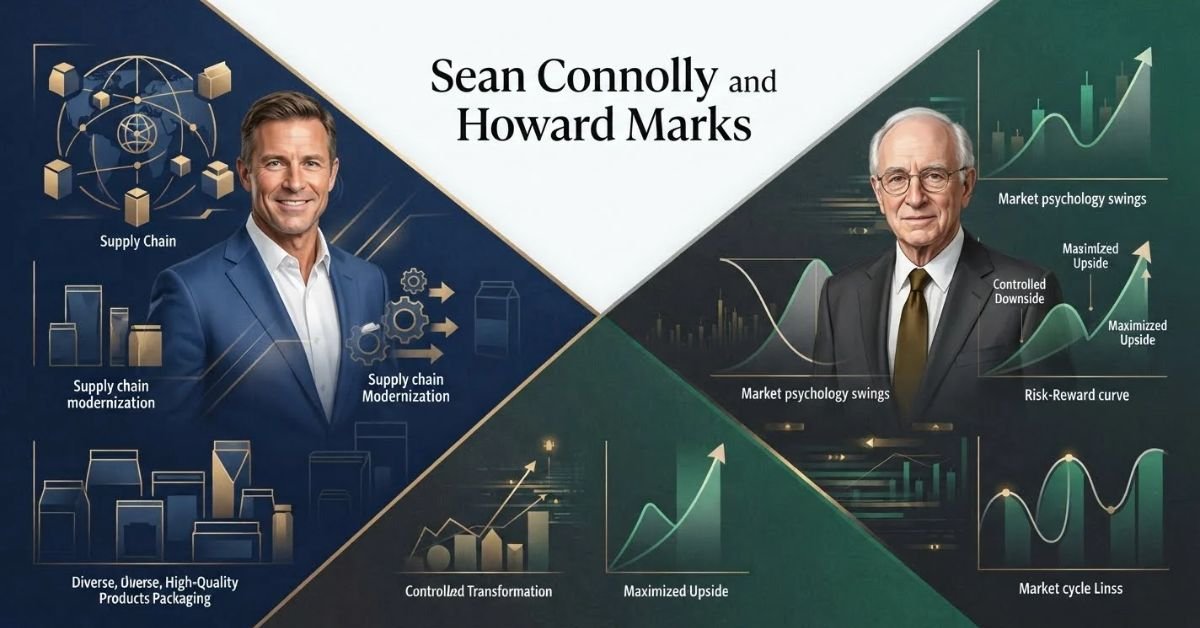
Sean Connolly is a retired consumer packaged goods (CPG) executive best known for his 11-year tenure leading Conagra Brands, while Howard Marks is a billionaire investor and co-founder of Oaktree Capital Management. Though they built their legacies in different arenas—packaged food operations and distressed debt investing—both leaders are recognized for navigating complex market cycles, managing risk, and reshaping major enterprises.
Who Is Sean Connolly?
Sean Connolly is a veteran packaged food executive who served as President and CEO of Conagra Brands from 2015 until his departure on May 31, 2026.
- Education. He holds a Bachelor’s degree in Economics from Vanderbilt University and an MBA from The University of Texas at Austin.
- Industry Reputation. Over more than three decades in the consumer packaged goods sector, he built a track record of modernizing legacy food brands and streamlining corporate portfolios.
- Board Roles. Beyond his executive positions, he has served on the boards of organizations including SC Johnson, the Consumer Brands Association, Northwestern Memorial Hospital, and the Vanderbilt University Board of Trustees.
Sean Connolly’s Career Before Conagra Brands
Before taking the helm at Conagra, Connolly held senior leadership and brand-building positions across several major consumer goods corporations.
- Procter & Gamble (1992–2002). He began his career in brand management, spending a decade at Procter & Gamble and rising to the role of Marketing Director.
- Campbell Soup Company (2002–2012). He joined Campbell Soup Company and eventually became President of Campbell North America, overseeing core soup, sauce, and beverage operations.
- Sara Lee & Hillshire Brands (2012–2014). In 2012, he became CEO of Sara Lee’s North American Retail and Foodservice business. Following the company’s split, he served as President and CEO of Hillshire Brands until its acquisition by Tyson Foods in 2014.
Sean Connolly’s Leadership at Conagra Brands
Connolly joined Conagra Brands (then ConAgra Foods) in April 2015 and led a multi-year transformation that lasted until May 2026.
- Portfolio Overhaul. He shifted Conagra from a sprawling conglomerate into a focused, pure-play branded food company. Under his direction, the company divested slower-growing or non-core businesses—such as Chef Boyardee in 2025—while focusing heavily on frozen foods and snacks.
- Navigating Volatility. He guided the company through the COVID-19 pandemic, supply chain disruptions, and historic food inflation, instilling a competitive internal culture.
- Leadership Transition. Despite modernizing the brand lineup to generate nearly $12 billion in fiscal 2025 net sales, Conagra’s stock struggled against shifting consumer preferences toward healthier foods and private-label competition. In April 2026, the board announced Connolly would step down on May 31, 2026, with former J.M. Smucker executive John Brase succeeding him on June 1, 2026.
Who Is Howard Marks?
Howard Stanley Marks (born 1946) is an American billionaire investor, financial author, and the co-founder and co-chairman of Oaktree Capital Management.
- Academic Background. He earned a bachelor’s degree in finance from the Wharton School of the University of Pennsylvania and an MBA in accounting and marketing from the University of Chicago. He is also a Chartered Financial Analyst (CFA).
- Early Career. Marks began his finance career at Citibank, where he developed one of the earliest high-yield bond portfolios in the late 1970s. He later joined Trust Company of the West (TCW), where he managed distressed debt and convertible securities alongside future business partner Bruce Karsh.
- Thought Leadership. Marks is widely known across Wall Street for his periodic client memos on market psychology and risk, as well as his acclaimed investing books, The Most Important Thing and Mastering the Market Cycle.
Howard Marks and the Growth of Oaktree Capital Management
In 1995, Marks co-founded Oaktree Capital Management in Los Angeles with Bruce Karsh and four other partners from TCW.
- Distressed Debt Dominance. Oaktree rapidly grew into the world’s largest investor in distressed securities, focusing on credit, high-yield bonds, and alternative investments.
- Risk-First Philosophy. Rather than trying to predict macroeconomic swings, Marks built Oaktree around controlling downside risk, understanding market cycles, and buying assets below intrinsic value during market panics.
- Global Scale. Oaktree expanded to manage well over $150 billion in assets. In 2019, Brookfield Asset Management acquired a majority 62% stake in Oaktree, while Marks remained co-chairman and a key investment voice.
What Connects Sean Connolly and Howard Marks?
Sean Connolly and Howard Marks do not share a direct business partnership or corporate overlap, as they operate in entirely separate sectors. Instead, the two executives are often compared or grouped together in leadership profiles for their parallel approaches to corporate stewardship and market cycles:
- Cycle Management. Both leaders built their careers around reading changing environments—Connolly by adapting packaged food portfolios to shifting consumer habits and inflation, and Marks by positioning credit portfolios around economic booms and busts.
- Disciplined Allocation. Connolly reshaped Conagra by cutting underperforming divisions to focus on high-margin frozen and snack categories, mirroring Marks’ philosophy of avoiding uncompensated risk to protect long-term value.
Conclusion
Sean Connolly and Howard Marks represent two distinct forms of executive leadership. Connolly demonstrated how operational discipline and brand modernization can transform a traditional food giant over a decade, while Marks proved that rigorous risk management and psychological insight can build a premier global investment firm.
Quick Answers to Common Questions
- What did Warren Buffett say about Howard Marks?
Warren Buffett famously praised Marks’ client memos, stating: “When I see memos from Howard Marks in my mail, they’re the first thing I open and read. I always learn something.” - Who is Sean Connolly?
Sean Connolly is a retired consumer goods CEO who led Conagra Brands from 2015 to May 2026, following executive leadership roles at Hillshire Brands, Campbell Soup Company, and Procter & Gamble. - Is Howard Marks a billionaire?
Yes. Howard Marks is a billionaire, with Forbes estimating his net worth at roughly $2.2 billion. - Who is Howard Marks’ son?
Howard Marks’ son is Andrew Marks, a prominent technology investor who co-founded and serves as a managing partner at the venture capital firm TQ Ventures. He famously co-wrote the 2021 Oaktree memo “Something of Value” with his father, bridging traditional value investing with modern tech growth.
Howard Marks’ core investing principles
Howard Marks’ investing philosophy centers on controlling downside risk, practicing “second-level thinking,” and understanding market cycles rather than trying to predict the future. Through decades of Oaktree Capital Management memos and his books, he has distilled value and credit investing into practical rules focused on human psychology and price discipline.
Second-Level Thinking
Marks argues that average returns come from obvious, surface-level conclusions, while superior returns require thinking deeper and differently than the crowd.
- First-Level vs. Second-Level. First-level thinking is simplistic (“It’s a good company, let’s buy the stock”). Second-level thinking evaluates consensus expectations (“It’s a good company, but everyone thinks it’s great, so the stock is overpriced and I should sell”).
- Contrarian Discipline. To beat the market, an investor must hold a view that is both different from the consensus and more accurate.
Risk Control Over Return Chasing
For Marks, investment success is defined not by how much money you make in bull markets, but by how little you lose in bad ones.
- Asymmetric Returns. At Oaktree, the core goal is to capture most of the market’s upside during good times while experiencing far less of the downside during crashes.
- Risk Means Uncertainty. Marks rejects the academic definition of risk as simple price volatility. Instead, he defines risk as the permanent probability of losing money, which rises highest when investors feel no fear and pay inflated prices.
Price vs. Value
Marks emphasizes that there is no asset so good that it cannot become a bad investment if bought at too high a price.
- Buying Well. Investment success comes not from buying good things, but from buying things well—meaning at a price well below intrinsic value.
- Margin of Safety. Purchasing assets during moments of panic or forced selling builds a margin of safety, ensuring that even if things go wrong, the investor is protected.
Navigating Market Cycles
While Marks believes nobody can consistently predict macroeconomic events or interest rates, he insists investors must know where the market stands in its cycle.
- The Pendulum Swing. Investor psychology swings like a pendulum between extreme euphoria and deep depression, rarely resting at a rational midpoint.
- Calibrating Aggression. When capital is abundant and investors are greedy, Marks advises playing defense. When capital is scarce and investors are terrified, he advises shifting to aggressive buying.
Patience and Humility
Marks stresses that the biggest investing mistakes stem from ego, overconfidence, and the urge to constantly take action.
- Knowing What You Don’t Know. He divides investors into those who don’t know the future and those who don’t know they don’t know. Accepting unpredictability prevents over-leveraged bets.
- Waiting for Fat Pitches. Investors do not have to swing at every market movement. Patience allows capital to sit safely until forced sellers offer bargains.