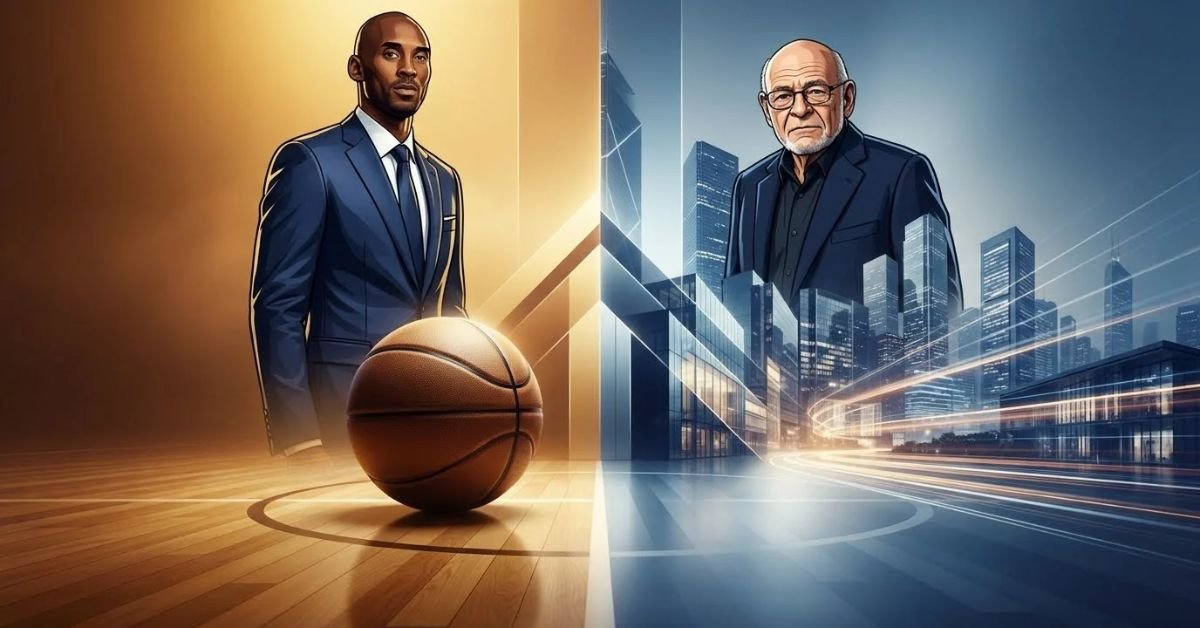
Greatness rarely follows a single script. On the surface, few figures could seem further apart than Kobe Bryant, the five-time NBA champion who captivated millions under the bright lights of Los Angeles, and Sam Zell, the leather-jacket-wearing billionaire financier who built an empire out of distressed Midwestern real estate.
Yet when both men took the stage as headline speakers at the 2016 SALT Conference in Las Vegas, their presence told a compelling story. Separated by nearly four decades and vastly different industries, Bryant and Zell shared an unmistakable DNA: an obsession with preparation, a refusal to follow the crowd, and the rare ability to reinvent themselves at the peak of their powers.
Who Was Kobe Bryant?
Born in 1978, Kobe Bryant spent his entire 20-year NBA career with the Los Angeles Lakers, evolving from an 18-year-old draft pick straight out of Lower Merion High School into one of the most decorated players in basketball history.
By the time he retired in 2016, Bryant had achieved a resume few athletes could match:
- Championship Pedigree: Five NBA titles, two Finals MVP awards, and the 2008 NBA regular-season MVP.
- All-Time Accolades: 18 All-Star selections, two Olympic gold medals, and an iconic 81-point single-game performance in 2006.
- Global Cultural Impact: Famous for his relentless work ethic—widely known as the “Mamba Mentality”—Bryant became a multilingual ambassador for basketball whose brand resonated worldwide.
His tragic passing in a January 2020 helicopter crash alongside his 13-year-old daughter Gianna and seven others cut short a second act that was already rivaling his playing career.
Who Was Sam Zell?
Sam Zell (1941–2023) was a self-made billionaire investor, real estate pioneer, and corporate turnaround specialist known across Wall Street as “The Grave Dancer.” Born in Chicago to Polish Jewish refugees who escaped Europe just before World War II, Zell earned both his undergraduate and law degrees from the University of Michigan. After practicing law for a single week, he walked away to pursue real estate full-time.
Zell started small, managing student apartments in Ann Arbor while still in college. In 1968, he founded Equity Group Investments, the private investment firm that launched his sprawling empire across real estate, energy, logistics, manufacturing, and healthcare. By the time of his death in May 2023 at age 81, Zell had amassed an estimated net worth of $5.2 billion and permanently reshaped modern commercial real estate.
Kobe Bryant’s Transition From Basketball to Business
For decades, the standard post-retirement playbook for superstar athletes consisted of endorsement deals and broadcast booths. Bryant tore up that script. Even before playing his final game, he began building a diversified business empire rooted in storytelling, venture capital, and consumer brands.
- Bryant Stibel & Co.: Co-founded with entrepreneur Jeff Stibel in 2013 and publicly launched in 2016 with $100 million in self-funded capital, Bryant Stibel invested in high-growth technology, media, and data companies. By late 2019, the firm managed over $2 billion in assets and held stakes in major names like Epic Games, LegalZoom, Alibaba, and Dell.
- Kobe Inc. & BodyArmor: In 2014, Bryant invested $6 million for a 10% stake in the upstart sports drink brand BodyArmor. Following Coca-Cola’s partial acquisition in 2018 and full buyout in 2021, Bryant’s stake grew in value to between $200 million and $400 million—one of the most lucrative athlete investments in history.
- Granity Studios: Driven by a passion for inspiring young athletes through narrative, Bryant founded Granity Studios. In 2018, he won an Academy Award for Best Animated Short Film for Dear Basketball, becoming the first former professional athlete to win an Oscar.
Sam Zell’s Investment Philosophy and Real Estate Empire
If Bryant approached business through brand and storytelling, Zell conquered it through contrarian math and fearless timing. He earned the moniker “The Grave Dancer” for buying distressed, undervalued assets during economic downturns and nursing them back to health. His guiding philosophy was simple: “If everyone is going left, look right.”
- Architect of the Modern REIT: Zell revolutionized commercial property by championing publicly traded Real Estate Investment Trusts (REITs), turning illiquid buildings into accessible investments for everyday shareholders. He founded and chaired three massive NYSE-listed giants: Equity Residential, Equity LifeStyle Properties, and Equity Office Properties Trust.
- The Historic $39 Billion Exit: In early 2007, right at the peak of the commercial real estate boom, Zell sold Equity Office Properties to The Blackstone Group for $39 billion. At the time, it was the largest leveraged buyout in history, a masterstroke of timing that shielded him from the 2008 global financial crisis.
- Global Expansion and Setbacks: Through Equity International, Zell pioneered public real estate vehicles in emerging markets like Brazil and Mexico. While most of his contrarian bets paid off handsomely, he was not immune to risk—most notably his 2007 leveraged buyout of the Tribune Company, which filed for bankruptcy the following year amid collapsing newspaper revenues.
Kobe Bryant and Sam Zell at the 2016 SALT Conference
In May 2016, just weeks after scoring 60 points in his unforgettable NBA finale, Kobe Bryant arrived in Las Vegas for the 8th Annual SALT Conference. Hosted by SkyBridge Capital, the annual summit brings together roughly 1,800 of the world’s top hedge fund managers, economists, and business leaders.
Sharing the marquee with Wall Street titans like Sam Zell, Ken Griffin, and T. Boone Pickens sent an unmistakable message: Bryant was not dabbling in business; he was entering the institutional arena. While Zell, a perennial SALT keynote favorite, delivered his trademark unfiltered commentary on real estate supply, capital discipline, and market risk, Bryant spoke candidly about translating his competitive obsession from the locker room to the boardroom. Though they spoke on separate panels, their shared billing captured a rare convergence—a rookie investor bringing cultural intuition to venture capital alongside a 74-year-old master of value investing.
Different Approaches to Leadership and Success
Both men built billion-dollar legacies, yet their day-to-day playbooks looked remarkably different:
| Dimension | Kobe Bryant | Sam Zell |
| Core Strategy | Brand-building, storytelling, and early-stage tech/consumer venture investing. | Contrarian value investing, distressed asset turnarounds, and industry consolidation. |
| Leadership Style | Intense, detail-obsessed perfectionist who pushed partners to match his standard. | Decentralized, irreverent culture empowering trusted executives with strict accountability. |
| Risk Profile | Targeted high-upside consumer disruption and intellectual property. | Prioritized downside protection, cash flow, and buying assets below replacement cost. |
| Public Persona | Polished, analytical student of craft mentored by icons like Oprah Winfrey and Jony Ive. | Outspoken maverick who wore jeans to board meetings and rejected Wall Street groupthink. |
Their Lasting Influence on Sports, Business, and Society
Today, the blueprints left behind by both Bryant and Zell continue to shape their respective worlds.
Bryant permanently changed what is expected of elite athletes. By building an Oscar-winning production company and a $2 billion venture fund, he proved that athletes could be true owners and creators rather than passive endorsers—paving the way for modern moguls like LeBron James, Kevin Durant, and Serena Williams. Off the court, his vocal support for the WNBA and founding of the Mamba Sports Academy helped accelerate visibility and investment in women’s sports.
Meanwhile, Zell’s creation of large-scale public REITs democratized commercial real estate, transforming it into a core asset class for pension funds and individual retirement accounts worldwide. Beyond finance, the Zell Family Foundation endowed major entrepreneurship institutes at the University of Michigan, Northwestern University, the University of Pennsylvania, and Reichman University in Israel, funding and mentoring thousands of aspiring founders.
Conclusion
Kobe Bryant and Sam Zell started from completely different worlds—one mastering footwork on basketball courts, the other dissecting balance sheets in distressed property markets. Yet their paths crossed at the highest levels of global business because both understood the same fundamental truth: lasting success demands obsessive preparation, independent conviction, and the courage to bet on yourself when everyone else expects you to stay in your lane.
Frequently Asked Questions (FAQ)
How did Kobe Bryant and Sam Zell cross paths?
Kobe Bryant and Sam Zell both appeared as headline speakers at the 8th Annual SALT Conference in Las Vegas in May 2016. Hosted by SkyBridge Capital, the event brought together global leaders in finance, business, and pop culture just weeks after Bryant retired from the NBA.
What was Kobe Bryant’s biggest business success after retiring from the NBA?
Bryant’s most famous business wins were co-founding the venture capital firm Bryant Stibel, which grew to manage over $2 billion in assets, and his early $6 million investment in BodyArmor. Following Coca-Cola’s acquisition of the sports drink brand, Bryant’s stake rose in value to between $200 million and $400 million. He also won an Academy Award in 2018 for his animated short film Dear Basketball.
Why was Sam Zell called “The Grave Dancer”?
Sam Zell earned the nickname “The Grave Dancer” because of his contrarian investment strategy of buying distressed, undervalued real estate and corporate assets during economic downturns and turning them back into profitable businesses.
What was Sam Zell’s largest real estate deal?
In early 2007, Sam Zell sold his commercial real estate company, Equity Office Properties Trust, to The Blackstone Group for $39 billion. At the time, it was the largest leveraged buyout in history and occurred right before the 2008 global financial crisis.
What did Kobe Bryant and Sam Zell have in common?
Despite coming from completely different industries and generations, both men built multibillion-dollar legacies through obsessive preparation, independent thinking, and a willingness to take calculated risks outside their initial fields—Bryant moving from basketball to venture capital and media, and Zell moving from law to real estate and global private equity.